
INTRODUCTION
In the previous article we came to define that the vibrations generated by a device or a machine are a source of information on the current state and that it is possible to identify faults through them. In this article we will analyze the vibrations from what and why they are generated and we will try to get a diagnosis through their analysis.
VIBRATIONS OF AN ELECTRIC MACHINE [ 1 ]
The main areas of vibration in rotating electrical machines are:
- Response of the stator core to the attractive force developed between stator and rotor
- Response of the heads of the stator windings to the electromagnetic forces in the conductors
- Rotor dynamic behavior
- Response of the shaft bearings to the vibration transmitted by the rotor
Electromagnetic forces
Most electrical machines base their operation on two principles:
- The force exerted on a conductor crossed by an electric current and immersed in a magnetic field (Lorentz Force)
- The force produced by ferromagnetic structures traversed by a magnetic flux (Maxwell Force)
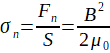
The force that tends to close the gap between two blocks of ferromagnetic material is defined as the radial force of the Maxwell tensor. The Maxwell tensor represents the electromagnetic forces that concur in a rotating machine and are perpendicular to the stator and to the rotor and symmetric, therefore with resultant zero. The perfect symmetry can occur if and only if the rotor and stator are perfectly concentric, so ideals. The Maxwell tensor can be represented in terms of magnetic induction ( B ) as follows:
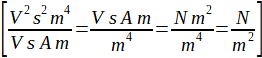
In the next lines there is the demonstration that the main vibration frequency of an electric motor is double the power frequency, so the following pages are the mathematical demonstration of this assertion.
The magnetic flux Φ is given by the magnetomotive force M divided by the reluctance of the magnetic circuit (figure a)

given that the reluctance of the air gap is much higher than that of the iron core, as a first approximation we tend to neglect this reluctance of the core in calculating the magnetomotive force necessary to produce a given flow of magnates Φ .
The reluctance to the air gap is (formule b)

where is it
- δ is the length of the air gap [m ]
- μ0 is pe r magnetic vacuum permeability [H / m ]
- S is the normal surface through which the flow passes [m2]
the flow Φ is given by the flux density d ell’induzione magnetic B that crossed in a perpendicular surface S (formula c)

putting together the previous formulas [a, b and c] is obtained
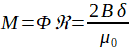
The main harmonic component of the magnetomotive force M, has a sinusoidal spatial distribution to the air gap, with a period that depends on the number of pairs of poles pp and amplitude variable sinusoidally over time as a function of the feeding frequency f

where is it


As a consequence the field B will have the same behavior and its first harmonic

Formula of magnetic induction

The radial component of the Maxwell tensor is proportional to the square of B, so raising the expression of B to the square

we remember that
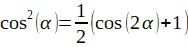
It should be noted that the radial component due to the Maxwell tensor has a sinusoidal component over time with a frequency twice the power frequency.
To which the main frequency of the stator case vibration is twice the power supply frequency, even when the rotor and stator are perfectly c or ncentrici.
In conditions of perfect symmetry between rotor and stator, if we integrate the Maxwell effort along the entire air gap we get that both the horizontal and vertical components are null. So we have to go and check in case of eccentricity
Static eccentricity
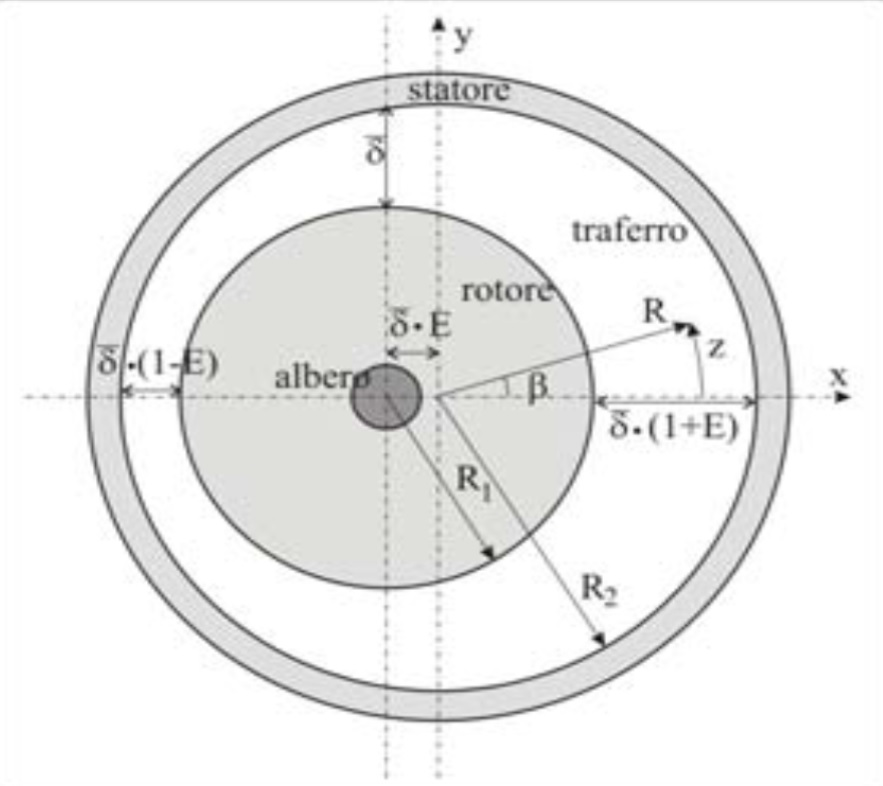
This is the situation in which the rotor axis is not in axis with the stator axis
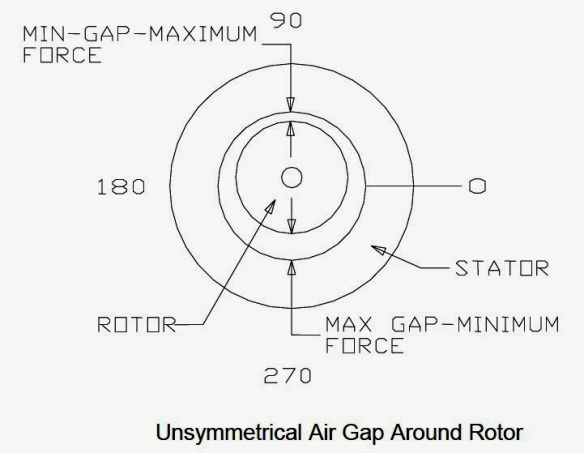
Since the rotor is symmetrical to its axis we have no mechanical unbalance. In this case the length of the air gap can be expressed

in the expression of magnetic induction we have that the length of the air gap is a denominator, so we must calculate the inverse
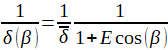
proves that

placing
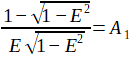
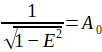
Knowing that you get it
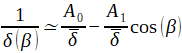
from this we can calculate the magnetic induction due to static eccentricity


placing
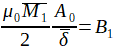
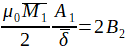
remembering that

you get


the induction to the air gap, in the presence of static eccentricity, is due to the interaction of three harmonics with different numbers of pairs of poles
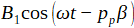
in the next two formulas for greater readability we have collected β


By integrating the Maxwell effort along the air gap, a resultant different from zero is obtained in the direction of the minimum air gap. So with static eccentricity there is an increase of the double vibration compared to the power frequency.
Dynamic eccentricity
the dynamic eccentricity is the case in which the rotor rotates around the axis of the stator and not to its own axis. Not coincident, it also has a mechanical unbalance, which can be expressed as a centrifugal force that rotates at the speed of the rotor. The air gap rotates at the speed Ω , so its length can be expressed as follows

the dynamic eccentric produces a rotating electromagnetic force at the rotor speeds Ω , which is added to that due to mechanical unbalance.
Following the same reasoning static eccentricity can be calculated by the expression magnetic induction B and the Maxwell tensor which is proportional to the square of B . It is found that dynamic eccentricity also produces vibrations at frequencies


having fs is the stator frequency and f r is the rotor frequency. Where in the asynchronous engines we will have

while in synchronous engines we will have

Methods to diagnose eccentricity
Asynchronous Motors
We see in the previous paragraphs that the amplitudes of the vibration harmonics 2fs , fr , 2fs ±fr
- it increases rapidly with eccentricity (static and dynamic) especially when empty
- static eccentricity has only a small influence on the frequency component fr
The amplitudes of the current harmonics at frequency fs±f r
- their amplitude is strongly dependent on the degree of eccentricity both static and dynamic
- the effect of dynamic eccentricity increases passing from the nominal load to the empty operation
To diagnose the rotor eccentricity in asynchronous cage motors, other current harmonics have been considered, which also depend on the number of rotor bars.
Synchronous generators
The current harmonics are at frequency 5fs , 7fs, 11fs , 13fs , 17fs , 19fs , their amplitude increases with the dynamic eccentricity for both types of rotor (smooth poles, salient poles).
Brushless motors
the amplitude of the radial force components and consequently the vibration harmonics increases with the dynamic eccentricity. Increases more in internal magnet motors than in surface magnet motors. Because the different position of the magnets creates a different distribution of the magnetic flux in the iron.
Conclusions
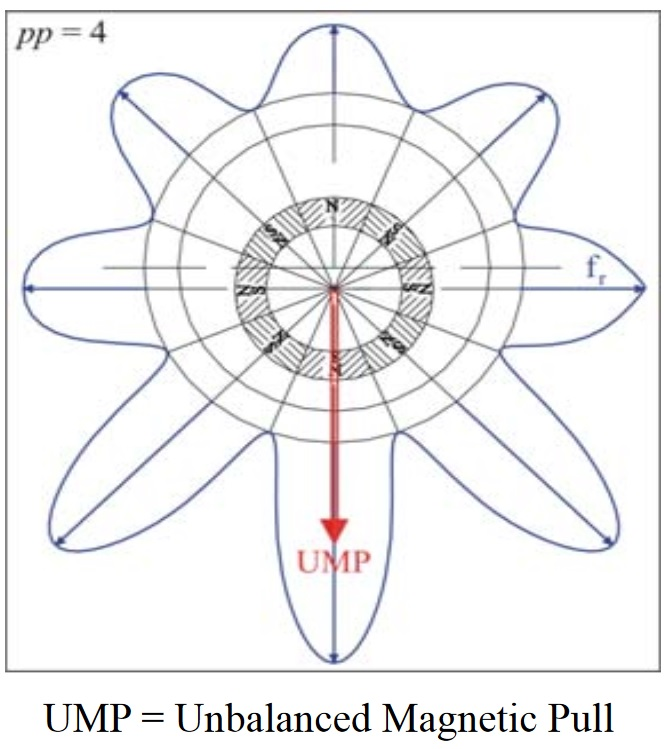
The eccentricity causes an unbalanced electromagnetic force on the rotor, called Unbilanced Magnetic Pull (UMP), which tries to move the rotor further. This can cause an increase in bearing wear. Furthermore the forces due to eccentricity subject the stator windings to potentially damaging vibrations. A high UMP can cause the rotor to rub on the stator.
Here I conclude, we focused mainly on the analysis of vibrations, as vibration analysis is the most widespread technique at the moment and allows us to diagnose a possible eccentricity of the rotor. I do not continue with diagnostics as the next points of analysis are not the subject of the current development of these pages. In the next articles we will address other topics of industry 4.0 such as communication, the management of the large amount of data generated by the various sensors present in a plant, for monitoring the status.
It should be noted that all the proofs are linear equations, but as we already know from the sixties, nature is certainly not a linear equation. A famous engineer said: God could not be more rude to use non-linear equations [2]. This is to anticipate that all the empirical results that we will find will always depart from the theory.It should be noted that all the proofs are linear equations, but as we already know from the 60s, nature is certainly not a linear equation. A famous engineer said: God could not be more rude to use non-linear equations [2]. This is to anticipate that all the empirical results that we will find will always depart from the theory.
BIBLIOGRAPHY – SITOGRAPHY
- [ 1 ] Vibration analysis 2 by Lucia Frosini, professor at the University of Pavia
- Does God Play Dice? The New Mathematics of Chaos
REVISIONS
- 25 December 2019 Publication