
INTRODUCTION
In the first article I started to describe what is Industry 4.0, giving importance, in addition to all the aspects that cover this new industrial revolution, to communication. In fact, all the gills that Industry 4.0 covers, without an interconnection between systems, therefore communication, Industry 4.0 and everything it entails is not possible.
We need to gather data from various devices and/or machines in order to analyze and to forecast their behavior. Without communication, stable and reliable, this in not possible.
In this article and in the nexts, I will begin an analysis of how electronic systems communicate, on what basis digital communication is based today. I will make a short story to introduce how communication protocols and standards were born. Today’s communication starts and is based on the ISO/OSI system, but before going into the study of this system, let’s see how the systems communicate.
SHORT AND INACCURATE HISTORY OF COMMUNICATION
This is not intended to be a detailed history of communication, but only a brief introduction.
Communication has always been the basis of the development of our civilization. At the beginning the communication was only verbal, then it started to be fixed on stone, with the rock drawings of the Neolithic

then on wax tablets and also the first begin remote communication with smoke or fire signals and with drums

later it was discovered the telegraph, Morse code, the phone, and from the phone discovery we can say that came the communication modern , with the transmission of voice, images, music and videos.
COMMUNICATION BETWEEN CALCULATORS[1]

Speaking of industry 4.0 we talk about communication between electronic devices. Electronic devices communicate mainly with two types of connections, parallel and serial. In the parallel communications the physical layer are constituted by a number of lines or wires, equal to the number of bits needed to form the information to be transmitted, on each line one bit. In the serial communications the physical layer is made up of a single line and the bits that make up the information are sent in sequence. Both of these communications need synchronization so that the receiver can recognize the information it receives.
Parallel communications for the moment we leave them aside and perhaps we will resume them later in more detail, here we will continue with serial communications as all communications are serial. Serial communications are less expensive than parallel ones since they take up less space both at the circuit level and at the overall level and therefore the infrastructures to support this technology have smaller overall dimensions.
Serial connections are divided into two groups, synchronous transmissions and asynchronous transmissions. Asynchronous transmissions are characterized by a line maintained at logic level 1, until data is transmitted. Before each set of data, the line is brought to logic level 0 for a period of time corresponding to a bit, this signals to the receiver the start of a data transfer and allows synchronization between source and receiver. The duration of the bit is known (both to the transmitter and to the receiver) as a transmission speed is defined. At the end of the message the line is brought to logic level 1 for a period of time equal to a certain number of bits.
In the synchronous transmissions, synchronization is given by a clock signal inherent in the data packet, which is pic\ked up by a special circuit called phase locking circuit. This technique is the most efficient and most suitable for high speeds.
For data transmission there are various encodings, all created to simplify the encoding and decoding circuits, and the most famous or better those that have spread most are:
– bipolar encoding or NRZ-L: the logical zero level is the high voltage level and vice versa
– NRZI coding: logic level 1 corresponds to a voltage transition, while zero corresponds to no transition
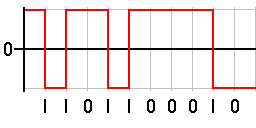
– Manchester coding: the voltage transition occurs within the time interval of the bit: 1 rising edge, 0 falling edge
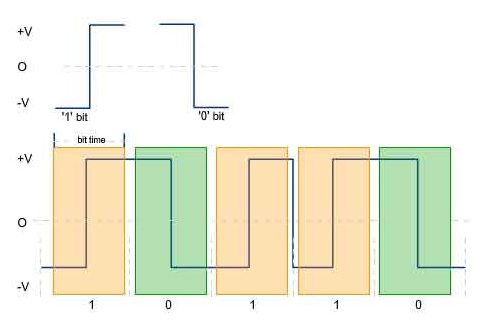
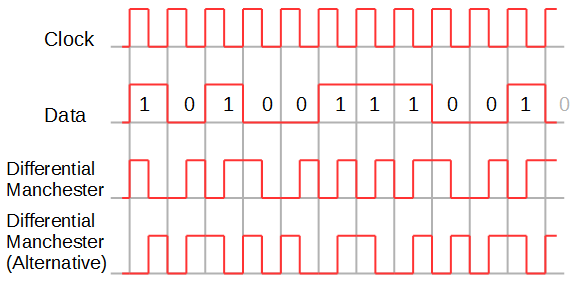
– Manchester differential coding: the transition takes place in the center of the bit time interval. The 0 corresponds to this transition, while the one is absent from this transition
Key features and issues of networks [2]
What characterizes a network are the following attributes
TOPOLOGY topology refers to the way in which the various stations or nodes in the network are connected
CIRCUIT SWITCHING AND PACKAGE SWITCHING NETWORKS the connection between two or more nodes can be done in two ways , usually:
– circuit-switched networks, in which a physical communication channel is established through the network, between sender and receiver
– packet-switched networks, in which messages are broken up into packets and transmitted across the network, to the recipient
CONTROL OF ACCESS TO THE TRANSMISSIVE CHANNEL In circuit-switched networks it is necessary to provide mechanisms that allow each user to request a connection to the desired partner. While for packet-switched networks in which all users are connected to a single transmission channel, the problem arises from time to time which of the users has the right to use the channel and to resolve any conflicts.
ROUTING OF MESSAGES In packet-switched networks there is the problem of establishing the path of packets within the network.
INTERCONNECTION BETWEEN DIFFERENT NETWORKS To solve this problem we need to rely on additional devices that take a different name depending on the number of ISO / OSI levels they implement.
CONCLUSIONS
Up to this point we have only made an overview of the various methods of creating a computer network. An overview necessary to be able to introduce the next articles that will analyze in more detail the ISO / OSI model and the internet, which we all know. This was necessary because there are many proprietary and non-proprietary communication methods or protocols in the industry, so we need to understand how to interface the various networks and collect or exchange the data we need . Given that Industry 4.0 is an innovation that gives the possibility of sharing and processing data, it is necessary to understand how these network architectures are born in order to connect them to each other. In this the ISO / OSI model helps us, which we will begin to see in the next articles.
BIBLIOGRAPHY – SITOGRAPHY
- [1] Engineer’s manual – New Colombo 84th edition – Third volume – Section N – Page 181
- [ 2 ] Engineer’s manual – New Colombo 84th edition – Third volume – Section N – Page 186
REVISIONS
- 13 APRIL 2020 Publication