
INTRODUCTION
With the article on Industry 4.0 it has been said that data analysis can prevent sudden machine downtime and therefore provide for repairs or replacements at times more suited to production.
Much of the theory of the industry 4.0 is based on an analysis of data, coming from various sensors distributed in the plant or in the machine, from this analysis comes a prediction about possible failures or downtime. Without a study or without having the basics of diagnostics and maintenance, even the best programmer / software will not be able to predict the deterioration of a given component. In this article, I will try to introduce the concept of diagnostics and maintenance, trying to maintain a general line so as to be able to cover the greatest number of cases.
DIAGNOSTICS
[1] Diagnostics: it is a translation procedure, of the information deriving from the measurement of the parameters and from the collection of data relating to the machine, in information on the actual or incipient failures of the machine itself. The diagnostics is a fault protection, that is, it activates when the fault has occurred, which is why in optical 4.0 it is necessary to transform the protection into prevention, but to perform this step it is necessary to understand the principles of diagnosis and maintenance.
[1] Here we start talking about preventive maintenance, which has some shortcomings:
– for obvious economic reasons maintenance interventions cannot be frequent
– during the revision phases, we try to carry out all possible repairs and replacements, even those that are not necessarily necessary. Increasing costs and times during these maintenance phases.
To solve these economic defects and at the same time maintain an efficient machine we must start talking about predictive diagnosis. This term means having the actual status of each component in order to predict or determine with a high degree of reliability, when the component can break, giving the possibility to plan targeted interventions and therefore to reduce maintenance costs.
DIAGNOSTICS OF ROTATING MACHINES
[ 2 ] We begin by analyzing the motors and their causes of failure, this is because the motors are present in all industrial automation and therefore one of the main causes of plant malfunctioning. In addition, knowing the main causes of failure it will be possible to have more accurate diagnoses.
Where can faults occur in an engine?
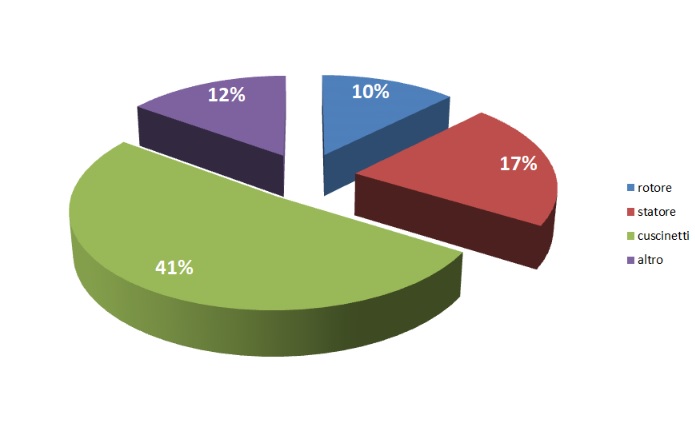
this argument is not easy to develop, as there is not much in the literature, and the little that is found is dated. Here I report a couple of studies, cited by professor Lucia Frosini of the University of Pavia, in her slides, you can find the link at the bottom of the article. The studies to which it refers are, one of EPRI (Electric Power Research Institute), the study is done on a sample of 5000 motors (in direct current and alternating current) used in different environments and applications with powers greater than 150kW, the greater part of them are asynchronous motors powered at a voltage greater than 1000V. This investigation was carried out in 1985. The other study is from 1995, and was carried out in the oil sector in Norway and concerns engines located in outdoor environments and with powers greater than 10kW and voltages lower than 1000V. The results of the two surveys are partially different, due to the size of the engines and the environment of use. The causes behind the failures are not easy to aggregate, but it can be deduced that the main causes are improper use, defective components and inadequate maintenance. In the following two graphs you can see the main components that are subject to failures.
CONCLUSION OF EPRI INVESTIGATION
CONCLUSIONS NORWAY SURVEY
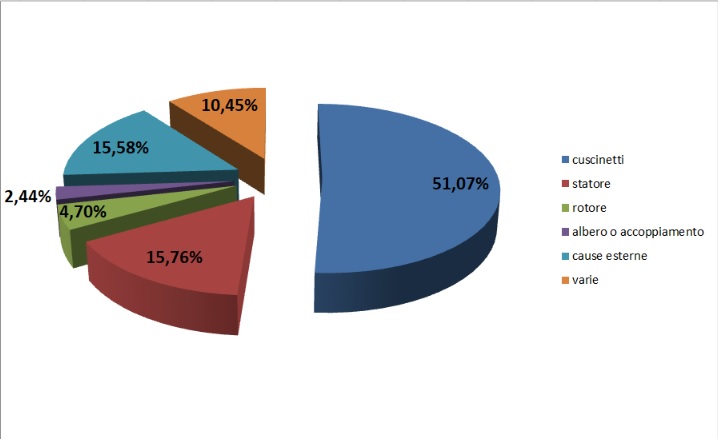
I make a clarification, in the second investigation is not explained the title “External device”, in the diagram I called “cause esterne”, so we can not assume anything about it. But what catches one’s eye is that in both studies the majority of failure cases are due to the bearings and stator windings.
A little while ago I mentioned the possible causes of the failures, improper use, defective components and inadequate maintenance. The first two causes will not be analyzed because they are outside the scope of this article, as they can be traced back to design errors. What I will analyze is inadequate maintenance. The meaning of this cause has as its main meaning an incorrect analysis of the problem, which involves an incorrect repair or maintenance action. Even in the industry 4.0 there can be these deficiencies, because the analysis is always performed by man and possible errors can be there, but with historical data and detailed analysis these errors can be reduced, and to achieve this we must mention artificial intelligence , which will be introduced in the next articles. The basic concept, to start analyzing any failures, is that when a motor or component is about to break down, there are warning signals that, if collected and analyzed, can prevent unexpected downtime. So the question is what should we analyze to see if a component is breaking? In an electric machine there are various aspects to be analyzed, electrical, magnetic, mechanical, fluid dynamic and thermal, and all interact with each other and therefore various fault indicators can be distinguished.
Electromagnetic indicators:
- current
- tensions
- partial discharges
- magnetic fluxes
mechanical indicators:
- noise
- angular speed
- power
- couple
thermal and chemical indicators:
- temperature
- oil and gas analysis
then we can measure the efficiency or the visual analysis, but among all the possible analyzes the most used is the measurement of the vibrations.
The vibrations are indicative of the forces generated by the motion of the rotor, in a rotating electric machine, especially due to its unbalance. Vibration analysis is aimed at identifying not only mechanical problems, but also electrical problems as an electrical anomaly produces an asymmetry in the distribution of the magnetic flux to the air gap and determines a variation in the dispersed flow, which produces a different distribution of forces electromagnetic and affects the progress of vibrations. For this reason, detection can also be useful on the motor casing. From this first approach it is clear that the machine’s vibrations change in the presence of faults. Unfortunately, they are not easy to identify because they are masked by other vibrations outside the machine itself. In any case, the analysis techniques of vibration signals have been developed to selectively highlight which parts can be subject to breakdowns or malfunctions, and based on the frequencies it is possible to determine what the failure could be. In determining whether a given frequency is due to a fault, we must begin to discern the various frequencies, especially the natural vibrations, which mask those vibrations that highlight a malfunction. Each machine produces its own vibrations, due to its mechanical characteristics, so it is necessary to eliminate all these frequencies to be able to determine a vibration that identifies a fault.
CONCLUSIONS
This concludes the first part of this long chapter, I decided to divide it into several parts in order to render easy to read. In the second parts, the analysis of the vibrations will be deepened to determine the faults and then the main causes of faults in rotating machines will be introduced.
BIBLIOGRAPHY – SITOGRAFIA
- [ 1] Introduction to diagnostics of electrical machines and drives by Lucia Frosini, professor at the University of Pavia
- [ 2 ] Vibration analysis 1 by Lucia Frosini, professor at the University of Pavia
REVISIONS
- 11 OCTOBER 2019 Publication
- 25 DECEMBER 2019 Link to follow articles update